26 June 2007

Poha – As homely as it gets…

Amchi Mumbai on a sunny Saturday noon.

During my vacation in Mumbai, we decided to go to Flora Fountain to buy books off the street. Aah, that's the beauty of Mumbai streets, you'll find just about anything there! After a long bus ride to Churchgate, we walked to Flora Fountain where there were rows and rows of book sellers. The thrill of finding books at one-fifth the original price and still bargaining with the vendor is unimaginable here!

Flora Fountain :
Commissioned by the Agri-Horticultural Society of Western India in the 1860's, the fountain was built in honour of the then Governor of Bombay, Sir Bartle Frere. The design was prepared by R Norman Shaw, and the fountain was sculpted in imported Portland stone by James Forsythe. The fountain cost Rs 47,000, a princely sum in those days. The statue flanking the top of the fountain is of Flora, the Roman Goddess of Abundance; and hence the name. On the lower tier are four statues on the four corners, depicting ladies in four different attires. Water spouts at different levels along with miniature collection pools and lion-headed gargoyles complete the fountain. True to its name, the sculpture also depicts an abundance of floral motifs. For more read
here.

Flora Fountain and BSE in the background.

BSE: Bombay Stock Exchange Limited, now synonymous with Dalal Street, is the oldest stock exchange in Asia. It is the first stock exchange in the country to obtain permanent recognition in 1956 from the Government of India under the Securities Contracts (Regulation) Act, 1956.The Exchange's pivotal and pre-eminent role in the development of the Indian capital market is widely recognized and its index, SENSEX, is tracked worldwide. For more read here.


BSNL: Bharat Sanchar Nigam Ltd. formed in October, 2000, is World's 7th largest Telecommunications Company providing comprehensive range of telecom services in India. Within a span of five years it has become one of the largest public sector unit in India. For more read here.

MCMG: The Municipal Corporation of Greater Mumbai was formed in the year 1873 as Mumbai's civic body. Through the multifarious civic and recreational services that it provides, the MCGM has always been committed to improve the quality of life in Mumbai.

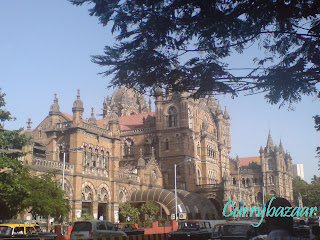
VT/CST: Modeled on the lines of the St Pancras Station in London, Victoria Terminus is undoubtedly the Raj's piece de resistance, complete with carved stone friezes, stained glass windows and flying buttresses. It is Gothic architecture at its best, an awesome edifice that most citizens view with deep pride. At the top of the central dome stands the triumphant figure of Progress. The station was christened to commemorate Victoria Jubilee Day in 1887 when India's first steam engine puffed out to neighboring Thane, about 45 kms away. Today it has been rechristened Chhatrapati Shivaji Terminus after the Maratha warrior. And the old steam engines have been replaced by electric ones. But to the 2.5 million commuters who push past its massive portals everyday, this is still VT, the pulse of a throbbing city.

One more look :
And after this long walk from Churchgate to CST, it was time for some ghane ka ras or sugarcane juice!!


Fond memories of Mumbai evoke thoughts of typical Mumbai food. So here's a recipe for poha, a simple yet versatile dish that one can whip up in minutes. It makes a quick and light breakfast on weekdays, healthy and wholesome with different combos of veggies and nuts thrown in. Each one has their own version of making this.

You need:
2 cups poha/beaten rice/avil
1 onion chopped
4-5 green chillies chopped (you may reduce the spice)
1 small potato boiled and chopped
a handful of boiled green peas
2 tbsp grated carrots
2 tbsp red/yellow bell pepper
a handful of peanuts and chana dalia
a sprig of curry leaves
1 tsp cumin seeds/jeera
salt, red chilli powder and turmeric powder to taste
1 tbsp coriander leaves chopped
juice of 1 lime

Put the poha in a colander and wash under running water. This way, the poha remains moist and soft and does not become soggy. Heat a tbsp oil/ghee in a deep pan. Throw in the cumin seeds and let it splutter. You may use mustard seeds instead if you prefer. Throw in the peanuts and chana dalia and let it turn red. I sometimes add cashewnuts and raisins for variety. Now add the onions and curry leaves and fry till the onions are translucent. Add the potato/peas/bell peppers/carrots/ any other combo of veggies you prefer and fry lightly. You may add a tomato if you like a tangy taste. Add the poha/beaten rice, salt, chilli powder (optional) and turmeric and mix well. Take off the flame, add a spoon of ghee on it if you like. Squeeze some lime juice over it and garnish with coriander leaves.


13 June 2007

Amritsari Fish Fry

Having lived in Mumbai all my life until three years ago, traveling in and around Mumbai was a breeze. All short distances were covered on foot. For longer distances there were autos, cabs, BEST buses and of course the local trains. Life then was commandeered by local train timings. One had to be ready by 8.45a.m., dash out of the house by 8.48, reach the station by 8.58 to catch the local at 9.02. Everything was clock-work. Road travel meant luxury, the rare taxi ride a treat! My family never felt the need to own a car; there were plenty of auto rickshaws to take you anywhere. Staying in the UAE has however, changed my perspective of “travel”. Here travel is by car or cabs. My recent vacation to Mumbai gave me a real feel of the city – again.

The taxi from the airport to home was a good (?) old fiat which offered no leg space for short people like me. Wonder how tall guys fit in…The luggage is tied to the cab – literally – since the CNG cylinders take up most of the boot space. My entire vacation was punctuated with plenty of travel through my dear old city and the traffic was a marvel. Very talented drivers skillfully maneuver around potholes, whiz from the left and exit from the right without warning. Motorists are unaware of lanes, seatbelts are unheard of (unless a policeman is watching at the highway), indicators are never used and side mirrors are for show only. I doubt if they watch rear view mirrors either. Traffic signals are amazing places – you can buy fresh bunch of roses, newspapers, peanuts, dusters and so on or get bullied by beggars, eunuchs and the like. It is alright if two wheelers and auto-rickshaws bump softly into cars - at the slow speeds they crawl, the bump is barely felt. Motorists can honk anywhere, anytime; overtake from the left or right as they please without as much an indication. A one-way road can fit in atleast six vehicles across its diameter, by-passers not withstanding. Maximum space utilization, you see. Animal lovers may sight a cow seated right in the middle of the road, blissfully unmindful of the traffic passing by or barking stray dogs running after your rickshaw. Pavements are hollow cavities with mud piled up on either side. Freshly tarred roads are as good as roads with potholes. Autos by far were the most amazing means of transport. They squeeze into the tiniest of spaces, drive effortlessly through oncoming traffic, graze against buses and yet don’t throw you out or topple over. Everyone who has traveled with me in an auto laughs at the way I hold on to it in fright. Travel by train is another story altogether. How I managed to find an edge and hold onto to something before the train pulled away is a mystery. To be honest, the Mumbai traffic is far better behaved than in other places. It's weird - I spent 20 odd years of my life traveling in Mumbai without a care, and within a short span of staying away I find that traffic crazy! I do love Mumbai – it's the city I grew up in, the place where my loved ones live and the place I'll return to – hopefully someday soon….

Well, I am trying to pour out my homesickness, nostalgia, depression and all crazy thoughts of being lonely after a wonderful vacation surrounded by family, catching up with friends and being pampered silly when I was unwell. It took some effort to write this post - phew it's finally out. And now, some spicy fish fry to elevate my spirits!


You need :

1 kg pomfret – cleaned
Juice of 4 limes
4 tbsp ginger-garlic paste
1 tbsp red chilli paste
1 cup besan/chickpea flour
1 tsp pepper powder
1 ½ tsp chat masala
A pinch of orange colour (optional)
1 big onion sliced
Oil for frying

Method:

Mix the lime juice, ginger-garlic paste, red chilli paste, pepper powder, chat masala and colour to form a smooth paste. Make slits on the fish. Apply the marinade on the fish nicely and leave it in the fridge for 2 hours. Pan fry the fish for about 3 mins a side till the fish is cooked. I prefer it crisp outside and moist inside. Add some salt to the sliced onions and serve along with the fish.


16 May 2007

Kadhai Subzi

A lot of events took place during my month long hiatus from blogging – the most important one being shifting into a new apartment, which we are trying to make into a home. Well, we have mostly settled into our new place, but the hiatus is still on as I'm flying to Mumbai for a two week long vacation. Will be back soon with interesting posts. There are two posts today – separate for easier indexing, do leave your comments on either or both, as you like.

I came across this colourful recipe for Kadhai Subzi is in an old issue of Living in the Gulf. I liked this recipe for not only the taste of the dish but also for the fact that very little oil goes into the preparation. Here it goes:

1 cup coloured bell peppers cut into juliennes
1 cup carrots and beans
½ cup baby corn cut in half
1 cup of shelled peas
1 cup cauliflower cut into florets

Blanch each of these vegetables individually and reserve.

1 tsp each of cumin, peppercorns, coriander seeds.

Roast individually, cool and crush coarsely.

A handful of red chillies
1 large onion sliced
1 tbsp each of ginger-garlic paste
2 tbsp oil
1 tsp turmeric powder


1 tsp red chilli powder
1 tsp garam masala
Salt to taste
1 ½ large tomatoes pureed
A handful of coriander leaves


Heat oil in a pan. Throw in the red chillies. When they begin to change colour, add the sliced onion and sauté. Then add the ginger-garlic paste and sauté. Add turmeric and cook for some more time. Add the pureed tomatoes, salt and red chilli powder and sauté till the oil separates. Add all the blanched vegetables, sprinkle a little water and cook for 5 minutes. Add the crushed cumin, coriander and peppercorns, garam masala and chopped coriander leaves, mix well and serve hot with rotis/naans.

Safety Moment #2: Kids in the Kitchen

Whenever we have kids visiting us, I have one eye on them…. perhaps I'm more watchful than their parents are since my house is not exactly child friendly. There are many artifacts, curios and the like which entice the little ones. The little ones even think that my glass topped centre table is the perfect surface to bang on! No, I'm not having any of that from them, nor will I let them eat my house plants! Which is why I have an eye on their innocent (?) activities. As a child's mobility and curiosity increases, appropriate supervision becomes essential. Involving children in our daily activities allows them to learn new things and also teaches them method, neatness and safety.

The focus of the Safety Moment this May is on Kids in the Kitchen. The sheer pleasure of kids helping in the kitchen is incomparable. Meeta is guest-hosting this event at The Daily Tiffin. Here are some pointers from my end, all researched from the internet and just plain common sense.

Keep all hot items at a safe distance from a child.

Remove tablecloths and placemats when toddlers are present. They can tug and pull on everything within their reach. Hot or heavy items can be easily pulled on top of them.

Keep children and pets away from the range when anyone is cooking and keep a close eye on them at all times.

An oven door can get hot enough to burn a youngster who might fall or lean against it. It can be particularly dangerous for a child just learning to walk who may use the door for support; the child is often unable to let go before suffering a burn. Keep small children out of the kitchen when the oven is in use.

Keep hot items, such as hot beverages and trays that have just come out of the oven away from the edge of counters, so that children are not able to reach them.

Always turn pot handles inward to prevent small children from reaching and pulling down a hot pan.

Don't store cookies, candies, chocolates or other treats near the stove. It might tempt little children to climb on the stove to reach them.

Children who are permitted to operate the microwave oven should be tall enough to be able to safely remove items from the oven. One major risk is facial burns, which occur among children whose height puts their face at the level of the heating chamber of the microwave oven.

Be sure children are old enough to understand the safe use of the microwave oven before allowing them to heat foods. Young children may not be able to read and follow directions and are at a higher risk potential than older children. Their height is also an important factor.

Remember, continuous and adequate supervision of children in the kitchen is of prime importance.

25 April 2007

Announcing Safety Moment # 2 : Kids in the Kitchen


This May, the focus of the Safety Moment will be on how safe your kitchen is for your kids. The theme for the month is Kids in the Kitchen. Meeta is hosting the Safety Moment at the Daily Tiffin.

9 April 2007

Pineapple Morukootan

Summer's arrived here and so have all the yoghurt based curries. It is somehow very enjoyable to have a yoghurt based curry with steamed rice on a warm summer noon. I had pineapple on hand and thought pineapple pulisheri. Wait a minute, we never made pulisheri at home. It was not made by any family member either. I had only heard the terms pulisheri and errissery but had no clue what it was. I was told it was made in South Kerala region. My grandma did give me a recipe for pulisheri but it was the same as morukootan. Can anyone help me with the differences between pulisheri /morukootan /errisseri /kaalan ??? Well, whatever the difference, we thoroughly enjoyed it. This is my entry to Green Blog Project hosted by Mandira. (Thanks for hosting Mandira!) No, I didn't grow pineapples, but I do grow the curry leaves which I use in tempering my curries, in chutneys etc. I do believe my home grown curry leaves have a lovely aroma than the huge store bought ones. Touchwood, it's the only plant has survived the harsh Middle East summers and always given me a steady supply of leaves.

To make the morukootan:


- Clean, chop into dices and cook 1 cup of pineapple (I added a tsp of sugar while cooking the pineapple.) You can also substitute with equal amount of mango, nendran pazham/banana, white pumkin/kumbalanga, yam/chenna or tomato.
- Grind together ¼ coconut grated, ¼ tsp cumin, 2 green chillies into a fine paste.
- Mix 1 cup curd with salt and turmeric and keep aside.
- In a pan, mix together the cooked pineapple/vegetable, coconut paste, and curd and cook till it starts boiling around the corners. Stir well and do not allow the curd to separate by over cooking. Remove from the flame.
- To temper, heat some oil and add ¼ tsp mustard seeds, ¼ tsp cumin, 2 red chillies broken and a handful of curry leaves and allow it to crackle. Pour over the morukootan and serve with steamed rice.

Here's a sneak peak at my tulsi/holy basil, methi -it died during a sandstorm :(- and this flowering plant thechi poovu –don't know the English name.


Do take a look at the Safety Moment here and leave your comments and suggestions there. I am taking a blogging break, will be back soon! See ya!